
As part of its ongoing cybersecurity strategy, The Division of Information Technology has implemented a mandatory two-factor authentication for the Enterprise Virtual Private Network (VPN)
What is two-factor authentication?The Cisco SD-WAN portion of this document was authored by Cisco 1.1 Document Audience This document was designed for Network Engineers and Network Architects. For additional product and company resources, please refer to the Appendix section. 1.2 Hardware Used Both Cisco vEdge and IOS XE-SD-WAN routers were tested. For the vEdge router, both a. TwoFactor with VPN. Launch your Cisco AnyConnect VPN client, you will be prompted for your FIU username, password, and a “second password”. In this second password field, you will specify your preferred verification method (“something you have”). In the second password field, you will be required to type “push”, “phone”,. Provide more information, what is the ASA Model, ASA code? Is this a new setup or a working one failing due to an upgrade to any connect 4.9? BB. Rate All Helpful Responses. Jan 29, 2018 Update from February 5, 2018: After further investigation, Cisco has identified additional attack vectors and features that are affected by this vulnerability. In addition, it was also found that the original fix was incomplete so new fixed code versions are now available. Please see the Fixed Software section for more information. A vulnerability in the XML parser of Cisco Adaptive Security. Download AnyConnect version 4.9.00576 for PC - free download AnyConnect for PC/Mac/Windows 7,8,10, Nokia, Blackberry, Xiaomi, Huawei, Oppo - free download AnyConnect Android app, install Android apk app for PC, download free android apk files at choilieng.com.
To increase security measures on your account, two-factor authentication requires two steps to log in. The first step is using something you know (i.e., your password), and the second step is something you have (i.e., cell phone) to securely verify your identity.
What is required to use the VPN?- Enroll your phone for two-factor
- Cisco AnyConnect client
AnyConnect
FIU implements the AnyConnect VPN client to allow FIU users to connect on and off campus to the FIU network through a Secure Socket Layer (SSL) protocol.
- Supported Operating Systems
- System Requirements
- AnyConnect Clients
- Installing the AnyConnect
Supported Operating Systems
Microsoft Windows
- Windows 10 (32-bit and 64-bit)
- Windows 8, 8.1 (32-bit and 64-bit)
- Windows 7 (32-bit and 64-bit)
MAC OS X
- Mac OS X 10.11, 10.12, 10.13, 10.14 x86 (32-bit) or x64 (64-bit)
- Mac OS X versions 10.10 and lower are no longer supported
Linux
- Linux
- Red Hat Enterprise Linux 6.x and 7.x (64-bit)
- Ubuntu 14.04 (LTS), 16.04 (LTS), and 18.04 (LTS) (64-bit only)
System Requirements
Microsoft Windows
- Pentium class processor or greater.
- 100 MB hard disk space.
- Microsoft Installer, version 3.1.
MAC OS X
- 50MB of hard disk space.
- To operate correctly with Mac OS X, AnyConnect requires a minimum display resolution of 1024 by 640 pixels.
Linux
- x86 instruction set.
- 32-bit or 64-bit processor.
- 32 MB RAM.
- 20 MB hard disk space.
- Superuser privileges are required for installation.
- libstdc++ users must have libstdc++.so.6(GLIBCXX_3.4) or higher, but below version 4.
AnyConnect Clients
MAC OS X
- Intel download 4.9.X
AnyConnect Secure Mobility Client for Android Devices
All Android AnyConnect packages are available for installation and upgrade from the Google Play Store
For additional information regarding supported Android devices, please visit Cisco's support documentation
AnyConnect Secure Mobility Client for Apple Devices
All Apple AnyConnect packages are available for installation and upgrade from the Apple App Store
For additional information regarding supported Apple devices, please visit Cisco's support documentation
TwoFactor
Enroll
In order to verify your identity, you will be required to enroll your phone (“something you have”) in FIU’s two-factor authentication system.
Please review these simple step-by-step instructions below to enroll your phone:
- Visit login.fiu.edu/enroll
- Log in using your FIU username and password
- When prompted, enter the phone number of the device you would like to enroll in two-factor authentication (FIU numbers will not be accepted).
- Specify what type of device corresponds to the enrolled number
- When prompted, enter the code you received
- You are now enrolled in two-factor authentication
TwoFactor with VPN
Launch your Cisco AnyConnect VPN client, you will be prompted for your FIU username, password, and a “second password”. In this second password field, you will specify your preferred verification method (“something you have”).
In the second password field, you will be required to type “push”, “phone”, or “sms”.
- Push: uses the DUO Mobile app *
- Phone: places an automated voice call *
- SMS: sends unique verification codes via text messages **
(*Note: Your carrier’s data and message rates may apply)
(**Note: Your carrier’s data and message rates may apply, 10 codes are sent in one text message to use 10 different times.)
Signing into Any Connect VPN using Two-FactorFAQs
SSL VPN is a client application used to connect to the VPN. This is an application, which gets installed on the computer. This client has support for 64bit systems. This is also known as the AnyConnect client.
Use your My Accounts username and password to access the FIU VPN.Visit https://myaccounts.fiu.edu for additional information.
AnyConnect client.
Yes. Please look above for supported devices.
If you need to connect to UCInet from off campus, the Virtual Private Network (VPN) is the solution for you. The VPN allows you to securely connect to vital campus resources like the UCI Libraries and KFS (Kuali Financial System) by encrypting the information you are sending over the network, protecting your data. In addition, it enables authorized users to mount network file shares from off campus.
Special Instructions during COVID-19 Pandemic: To help balance the load of increased remote access needs, we now have multiple VPN servers for different purposes. Please take the following into consideration when connecting:
(1) If you require VPN access to connect to resources that are hosted on UCI campus, use the Software VPN and enter vpn2.uci.edu in the Ready to Connect field, then choose Default-UCI as the Group. Only if connections to this server are unavailable, should you then try vpn.uci.edu as an alternative.
(2) If you require VPN access to connect to resources that are hosted off campus but require a UCI IP address(i.e. Libraries' licensed online resources), use the Software VPN and enter vpn.uci.edu in the Ready to Connect field, then choose UCIFull as the Group.
(3) If you require VPN access to connect to some compatible web resources that are hosted off campus but require a UCI IP address, you can also use the WebVPN by going to https://vpn.uci.edu and choose WebVPN as the GROUP.
(4) If you use cloud-based or campus resources that don't require VPN to access, please don't connect to the VPN.
3 Ways to Access the VPN
Software VPN
Download, install and configure the Software VPN Client
- macOSRecommendedVersion 10.14 Mojave or newer - see below for more details)
VPN Software Version
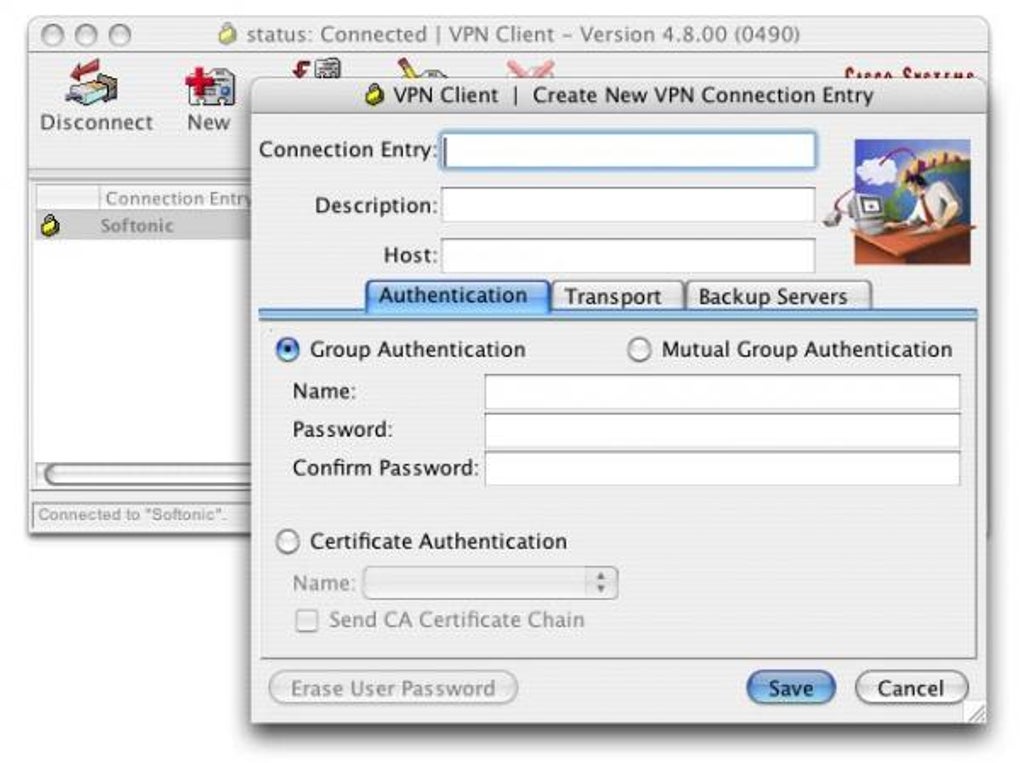
As of December 7, 2020, the current versions of the Cisco VPN client are as follows:
- macOS
- 4.9.04043 (for Big Sur, 11.0)
- 4.9.03047 (Catalina, 10.15)
- 4.9.00086 (for Mojave, 10.14)
- Windows
- 4.9.00086 for Windows 10 desktop and laptop users
- 4.9.00086 for Microsoft Surface Pro X users (the Pro X version uses an ARM-based processor).
- Linux
- 4.9.00086 (64-bit only)
Notes for macOS users: During the installation, you will be prompted to enable the AnyConnect software extension in the System Preferences -> Security & Privacy pane. The requirement to manually enable the software extension is an operating system requirement.
Peer-to-peer file sharing services and other high-bandwidth applications should not be used while using the VPN service. You may be automatically blocked from using the VPN if your bandwidth exceeds the maximum bandwidth limit.
iOS, Android, Chromebook
- How to install, configure & use the VPN Software
WebVPN
Need to access a UCI only website? Use the WebVPN. If you need to use an application, try the VPN Software option.- Login to the WebVPN
- Make sure to change the GROUP to WebVPN
VPN FAQ
I'm having trouble accessing certain online journals or resources while using the VPN.
There are two specific reasons why this may happen to you:
- You're using the WebVPN
- You're using the Software VPN but didn't connect using UCIFull.
Access to all of the library's online resources is restricted to the UCI IP network address space, so the only way to truly simulate as if you were working on campus is to use the 'UCIFull' Group setting when you first login using the Software VPN.
When you choose UCIFull, all of your off-campus traffic passes through the VPN, so from the point of view of the library's online resources, it's as if you're on campus. This is important because many of the online resources (such as JSTOR) are behind paywalls, and anyone trying to access those resources from off campus will need to pay to access them. The UCI IP network is whitelisted so you don't have to pay.
When you use the UCI Groupsetting, your home network won't use the VPN tunnel unless you're visiting a UCI website. So, when you visit a non-UCI site like JSTOR, it'll appear as if you're connecting from off-campus and you'll be paywalled.
The WebVPN is a fast, convenient way to access some of the library's online resources from off-campus simply by using a web browser; however, due to technical limitations of SSL (or browser-based) VPNs that are beyond the scope of this article, you will NOT have unfettered access to everything as you would if you were using one of the library computers or using your own computer on our campus network.
OIT's scope of support is ensuring you're able to login to the VPN. If you're logged in and using the UCIFULL tunnel but are still having trouble accessing or using certain journals, please visit https://www.lib.uci.edu/ask-librarian-reference-services. The UCI Libraries Reference Services Team are best equipped to assist you with these issues.
Why then are there two 'UCI' Groups to choose from in the Software VPN?
The 'UCI' Group is a 'split tunnel' versus the 'UCIFull' Group which is a full tunnel.
The 'UCI' Group is useful for staff & faculty who need access to some online resources while off campus (e.g. their work computer in their office) but don't need to tunnel all of their traffic through the VPN. There may be some personal or non-university business that you'd prefer not to be routed through the VPN. If you're using your computer to do some work but are also streaming a movie from Netflix, for example, you don't want the Netflix movie to stream through the VPN tunnel.
For one, the encrypted tunnel isn't as fast so your streaming will certainly lag, and now you're consuming too much network bandwidth by streaming a film through our encrypted network, which could actually lead to you being blocked. The VPN is to be used for university business only.
Cisco Vpn Client 4.9 Mac
If you have tried everything above, and you are still unable to access a specific resource (and other resources work fine), then you may want to contact the UCI Library to verify that the resource is a part of their catalog.
I'm having trouble using the WebVPN
If you’re having trouble logging in to the WebVPN (https://vpn.uci.edu):
- Make sure the Group is WebVPN
- Make sure you enter your UCInetID in all lowercase (UPPERCASE will not work).
- Try using a different web browser.
- If you’ve forgotten your UCInetID password, you can reset it here.
Cisco Vpn Download
If you’re still having trouble, wait about 30 minutes and try again, or try from a different location.
Once you're in the WebVPN, here are instructions on how to navigate the system (including how to visit other websites).
Note: PubMed have made changes to their site layout, and as a result it does not function properly in the WebVPN. There is no way to fix this issue, so please use the Software VPN instead.
I'm having trouble using the Software VPN
Login Trouble
If you’re having trouble logging into Cisco AnyConnect (aka the Software VPN), make sure you've carefully followed the steps provided for your operating system under the 'Software VPN' tab on the main VPN page. In particular:
- Enter the correct hostname vpn.uci.edu and then click Connect.
- When prompted, make sure you've selected the correct Group (IMPORTANT: use UCIFull if you want to access UCI Library resources from off-campus).
- Make sure you enter your UCInetID in all lowercase (UPPERCASE will not work).
- If you’ve forgotten your UCInetID password, you can reset it here.
If you're still having trouble, it's possible that you may be blocked due to a DMCA complaint. Learn how to get unblocked.
Error Messages
We have a list of common error messages in the next section.
What are some common error messages when using the Software VPN?
The most common errors that our users see are:
- 'Login failed'
- 'AnyConnect was not able to establish a connection to the specified secure gateway'
- 'The VPN client agent was unable to create the interprocess communication depot'
- 'Login Denied. Your host does not meet the requirements to connect. Visit wiki page...'
- 'The VPN connection failed due to unsuccessful domain name resolution'
- 'MTU size too small'
- 'On my Mac, some of the options are grayed out during installation or I'm getting the error 'a newer version is already installed'
I have a red circle inside the AnyConnect icon on the status bar - Roaming Security: You are not currently protected by Umbrella. Profile is missing.
OIT does not offer any of the extra 'protections' offered by Cisco that come bundled in the installer, which is why you're getting that false positive from the 'Roaming Security' feature when you run the client.
To fix this issue, uninstall the Cisco client for Mac (using the built-in uninstaller located in the /Applications/Cisco folder). After you restart your computer, download the Cisco VPN client and run the install again, only this time uncheck *all* the boxes in the installer except for the main VPN.
My VPN connection keeps dropping
Persistent connection drops are generally an issue on the network between you and UCI. The best place to start is by power-cycling everything between you and your ISP - your computer, router, cable modem (or whatever device connects you to your internet provider)
If the problem persists, completing the steps below will provide us with additional information needed to troubleshoot further.
Windows
- Open Command Prompt
- Enter the following: tracert -d vpn.uci.edu
Mac / Linux
- Open Terminal
- Enter the following: traceroute -n vpn.uci.edu
Once run, you can either screenshot or copy & paste the results of these commands in an email to oit@uci.edu
Why are older versions of macOS not supported?
Apple officially supports/provides security patches for the current OS version (macOS 11 Big Sur) plus the previous two, so our recommendation is that you upgrade to at least macOS 10.14 (Mojave). Your system could be vulnerable to attacks that are fixed in newer releases, and your system could be compromised and used to attack other systems (and possibly used to attack UCI when you are using the VPN).
In addition, there are bug fixes and security updates to the VPN client that necessitate it being updated to fix problems other users are having and to prevent security issues with older clients.
If you're running an older version than the ones mentioned above, please update your operating system. Faculty and staff should partner their with their local CSC, and students should reach out to AntTech for assistance.

The OITHD cannot assist with OS upgrades, and we cannot implement any changes to the network to get your computer to connect to the VPN. We apologize for the inconvenience. You may continue to use the WebVPN at https://vpn.uci.edu
Are there other VPNs besides vpn.uci.edu?
Cisco Vpn 4.9 Review
Yes. There are numerous departmental VPNs that are managed by the OIT Security Team and are restricted to those department's employees. Unlike vpn.uci.edu, access to those VPNs is restricted to certain staff members whose computers must meet very high security requirements.
In addition, some departmental VPNs may require you to use Duo two-factor authentication. Learn more about Duo.
If you're having trouble accessing your department's VPN, consult this FAQ article. If you're still having trouble, please partner with your school's CSC or if you work for OIT, you may open a ticket with us.
I need to access FACNet but am having trouble logging in to the VPN.
OIT provides desktop support for the Facilities Management department, which oversees the massive network of HVAC and other mission-critical environmental systems across campus. Access to the Facilities Network (or 'FACNet') is restricted with its own VPN, Duo 2-factor authentication and separate login credentials.
If you are a Facilities employee or third-party contractor/outside vendor having trouble accessing FACNet, please open a ticket with our Desktop Support team.
What are the VPN timeouts and limitations?
Timeouts
Once you bring up your VPN client and initiate a connection, you will remain connected as long as you’re actively using it. If the connection is idle for one hour, it will “timeout”. If you are not going to use your computer, it is best to take down the connection yourself, to free-up a tunnel for someone else to use. In either case, when you later come back to your computer you will need to re-initiate a connection if you still need to use the VPN.
Limitations
There is a limit of 2 VPN tunnels which may be simultaneously established under one UCInetID.
The campus VPN provides off-campus users access to university resources not normally available to remote users and is thus a critical resource. The VPN appliance handles connections for all users through the same interface. Users of bandwidth-intensive applications that are not related to the University’s academic mission can detrimentally impact other users on the VPN.
For this reason, peer to peer (p2p) file sharing programs (as well as internet gaming and other recreational, high-bandwidth applications) are not allowed on the VPN.
What are the VPN IP Addresses?
For those of you who would like to allow or restrict access from VPN users, here are the possible address ranges that VPN users will be using.
- 128.195.64.100 - 128.195.79.254
- CIDR Format: 128.195.64.0/20
- 128.195.80.0 - 128.195.83.254
- CIDR Format: 128.195.80.0/22
- 172.23.0.0 - 172.23.15.254
- CIDR Format: 172.23.0.0/20
Do I need to use the VPN while I'm living in one of the on-campus housing communities?
If you live in one of the ACC communities, then you are technically not on UCI's network and will need to use the VPN. If you live in any other housing community, then you do not need to use the VPN.
Cisco Vpn 4.99
I've tried the steps above and I'm still having issues
We recommend you continue your search in our comprehensive ServiceNow Knowledge Base.
If you're still having trouble, feel free to open a ticket. When doing so, please provide the following:
- Your full name
- Your UCInetID (the first part of your email address, not your ID number)
- A detailed description of the issue
Failure to provide this information will delay our response.
Cisco Vpn 4.9 Download
Return to the OIT Help Center.